
Eight grades from Europe's largest acetic acid producer - glacial, food grade, USP pharmaceutical, chemically pure and low-carbon Hull material - supplied worldwide with full manufacturer documentation.
Request a QuoteBouling Group Co., Ltd supplies the INEOS Acetyls acetic acid portfolio to manufacturers in the food, pharmaceutical, chemical and water treatment industries. Every order ships with the manufacturer's documentation - certificate of analysis, safety data sheet and grade specification sheet - so your quality team can qualify material before it reaches your plant.
Working with INEOS Acetyls, the only industrial-scale manufacturer of acetic acid, acetic anhydride and ethyl acetate in Europe, we handle grade selection, export packing and dangerous goods paperwork under one named contact. Your inquiry goes directly to Quinn Chai, who matches your application to the right grade and follows it through to delivery.
Eight grades cover every duty from bulk industrial neutralization to food, pharmaceutical and low-carbon applications. Each grade below is supplied with its manufacturer specification sheet and certificate of analysis.
The 99.85% glacial grade manufactured at Saltend Chemicals Park, Hull, specified with a freezing point of 16.35 °C minimum. Because the same INEOS material meets FCC, USP, BP and Ph. Eur. monographs, one grade can serve food, pharmaceutical and industrial orders alike. It is produced by Europe's largest manufacturer of acetic acid.
High-concentration acetic acid solutions for processes where glacial material is unnecessary but dilute grades cost too much handling volume. Suited to esterification feeds, pH adjustment and effluent neutralization duties.
Acetic acid solutions above 80% concentration for acidification, hydrolysis and industrial cleaning systems. The mid-range assay keeps freeze risk low during cold-season storage and transport.
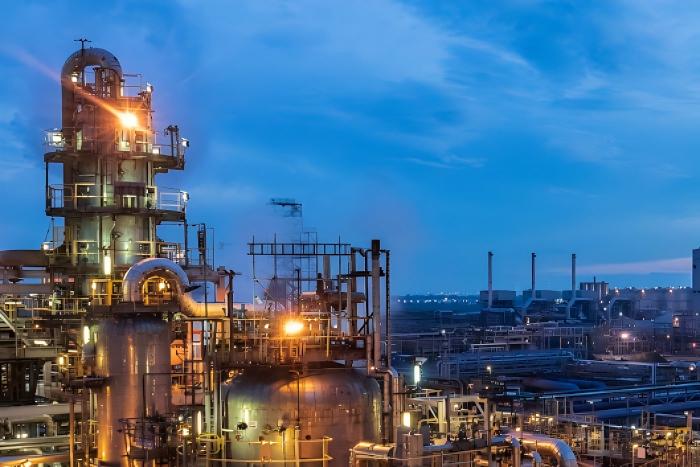
Acetic acid produced at the Hull site, which INEOS converted from natural gas to clean-burning hydrogen in a £30 million project. The conversion cut site CO2 emissions by 75% - the equivalent of removing around 160,000 petrol cars from the road - and the hydrogen is a co-product of existing on-site manufacturing. Buyers working toward Scope 3 reduction targets get the same specification profile with a substantially lower product carbon footprint.
General-purpose chemically pure acetic acid for industrial and chemical processing. Used as an input for acetate esters, monomer production, textile processing and metal treatment, where consistent assay keeps downstream chemistry predictable.
An acetic acid grade with propionic acid held at low levels for sensitive oxidation and esterification chemistry. It matters in purified terephthalic acid (PTA) plants and vinyl acetate monomer units, where carboxylic acid carry-over affects catalyst life and product color.
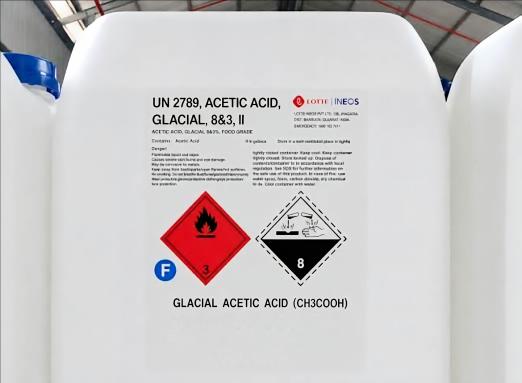
Glacial acetic acid meeting Food Chemicals Codex requirements, listed as E260 / INS 260 and affirmed GRAS under FDA 21 CFR 184.1005. The grade is specified at a minimum assay of 99.85 wt% with arsenic below 0.2 ppm and heavy metals below 0.5 ppm, making it suitable for pickling brines, sauces, flavoring and food preservation.
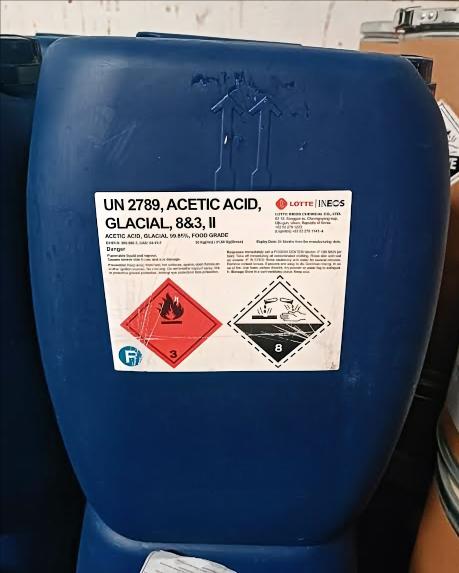
Pharmaceutical glacial acetic acid conforming to the United States Pharmacopeia monograph; the same INEOS material also meets British, European and Japanese pharmacopoeia standards. Applications span active pharmaceutical ingredient synthesis, drug formulation, dialysis solutions and medical device manufacturing.
Acetic acid (CH₃COOH) is a clear, corrosive organic acid that solidifies just below room temperature in its glacial form. The identification and physical data below apply across the grade range; grade-specific limits are set out in each specification sheet.
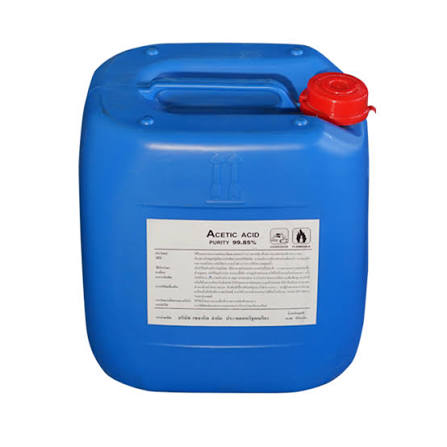
Food and pharmaceutical buyers need documented purity, not assumptions. INEOS publishes fixed limit values for each regulated grade, and Bouling Group passes the current specification sheet with every offer so your registration and audit files are complete from the first order.
Food grade status. Affirmed GRAS under FDA 21 CFR 184.1005, listed as E260 / INS 260 and produced under cGMP to Food Chemicals Codex requirements.
Pharmacopoeia coverage. The glacial material conforms to USP, British Pharmacopoeia, European Pharmacopoeia and Japanese Pharmacopoeia monographs, letting one grade serve several regulated markets.
Trace impurity limits. Food grade arsenic is limited to 0.2 ppm and heavy metals to 0.5 ppm, with nonvolatile residue capped at 10 ppm and readily oxidizable substances checked by color test.
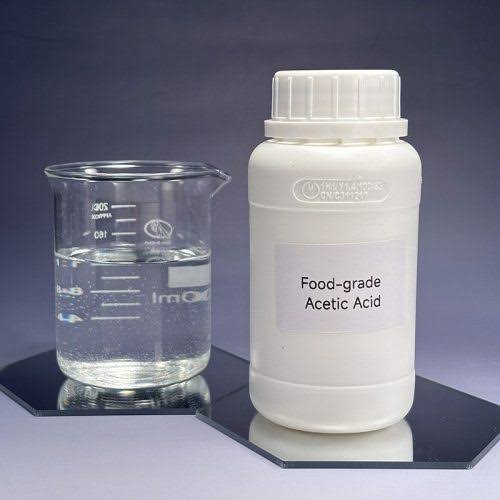
Acetic acid is one of the most widely used building blocks in the chemical industry, and the grade you choose is defined by the impurity limits your process can accept. The main fields served by this portfolio are set out below.
Food grade E260 acetic acid works as a preservative and acidity regulator in pickles, sauces, condiments and brines, where clean organoleptic profile and controlled heavy-metal limits are mandatory.
USP grade material feeds active ingredient synthesis, formulations and dialysis concentrates, where each batch must carry pharmacopoeia-compliant certificates of analysis.
Vinyl acetate monomer, acetate esters and purified terephthalic acid plants run on high-purity feedstock; low-propionic grades protect catalyst life and final product color in these trains.
Solutions between 80% and 98% serve pH adjustment, effluent neutralization and industrial descaling, where concentration can be matched to dosing systems and storage temperature.
The strength of this portfolio comes from the plant behind it. INEOS Acetyls publishes figures that matter to buyers weighing security of supply against carbon targets.
INEOS Acetyls is the only industrial-scale manufacturer of acetic acid, acetic anhydride and ethyl acetate in Europe, and the largest producer of acetic acid in the region. For European buyers this means security of supply without long inbound ocean legs, and for global buyers it means material made to world-class production standards.
The Hull site sits at Saltend Chemicals Park and employs more than 300 of the business's 500-plus people worldwide.
A £30 million conversion switched the plant from natural gas to clean-burning hydrogen, cutting site emissions by 75% - the equivalent of taking around 160,000 petrol cars off the road.
The business has supplied acetic acid and acetic anhydride to North and South America for more than 45 years, and remains one of the largest acetic acid suppliers in Asia.
Food, USP and pharmacopoeia monographs are covered by the same glacial material, so regulated buyers qualify one source instead of several.
Quinn Chai sends the current INEOS grade documentation, certificate of analysis and safety data sheet with every offer.
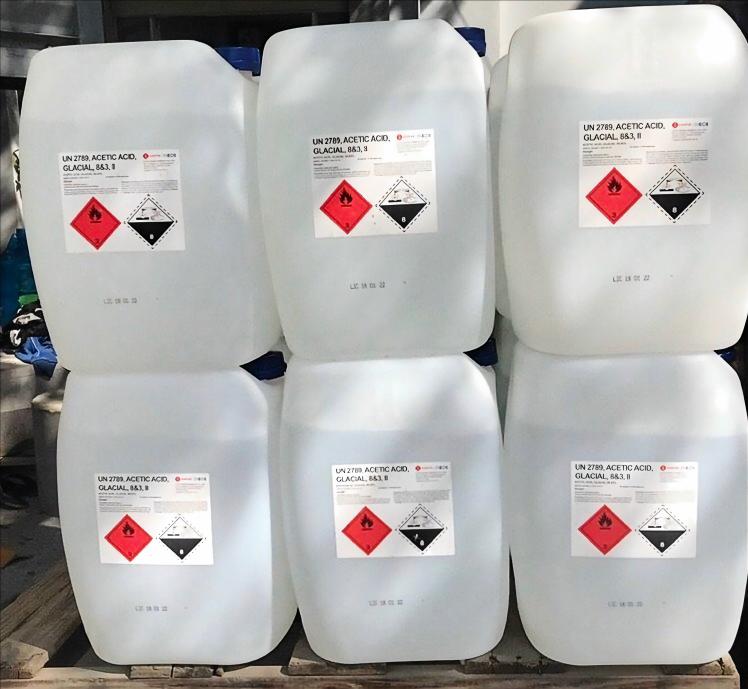
Acetic acid ships as a dangerous good under UN 2789, Class 8 (3), Packing Group II, so export orders reward early planning. Quinn Chai runs each order through four fixed stages.
Send your application, target concentration and destination; Quinn Chai matches them to the right INEOS grade and current availability.
Specification sheet, certificate of analysis and safety data sheet are issued with the offer so your quality team can approve the material before shipment.
Material is packed for export and moves with full dangerous goods documentation under UN 2789, Class 8 (3), PG II.
Glacial material solidifies near 16.6 °C, so tanks and lines are kept above that temperature; it is handled in stainless steel or approved plastics with corrosive-resistant PPE and ventilation.
Tell us the grade, quantity and destination port, and you will receive a specification sheet, indicative quotation and packing proposal in one reply. Inquiries for INEOS acetic acid - glacial, food, USP pharmaceutical, chemically pure, low-propionic, solutions or low-carbon Hull material - are all handled directly by Quinn Chai at Bouling Group.

Scan to chat with Quinn Chai on WhatsApp.



